
Are all cryptocurrencies the same
Each of our coin data pages has a graph that shows both the current and historic price information for the coin or token. Normally, the graph starts at the launch of the asset, but it is possible to select specific to and from dates to customize the chart to your own needs https://generoustroopers.com/. These charts and their information are free to visitors of our website. The most experienced and professional traders often choose to use the best crypto API on the market. Our API enables millions of calls to track current prices and to also investigate historic prices and is used by some of the largest crypto exchanges and financial institutions in the world. CoinMarketCap also provides data about the most successful traders for you to monitor. We also provide data about the latest trending cryptos and trending DEX pairs.
The very first cryptocurrency was Bitcoin. Since it is open source, it is possible for other people to use the majority of the code, make a few changes and then launch their own separate currency. Many people have done exactly this. Some of these coins are very similar to Bitcoin, with just one or two amended features (such as Litecoin), while others are very different, with varying models of security, issuance and governance. However, they all share the same moniker — every coin issued after Bitcoin is considered to be an altcoin.
Related Links Are you ready to learn more? Visit our glossary and crypto learning center. Are you interested in the scope of crypto assets? Investigate our list of cryptocurrency categories. Are you interested in knowing which the hottest dex pairs are currently?
Do all cryptocurrencies use blockchain
By integrating blockchain into banks, consumers might see their transactions processed in minutes or seconds—the time it takes to add a block to the blockchain, regardless of holidays or the time of day or week. With blockchain, banks also have the opportunity to exchange funds between institutions more quickly and securely. Given the sums involved, even the few days the money is in transit can carry significant costs and risks for banks.
This system can be seen as both a pro and a con. It gives anyone access to financial accounts, but allows criminals to transact more easily. Many have argued that the good uses of crypto, like banking the unbanked, outweigh the bad uses of cryptocurrency, especially when most illegal activity is still accomplished through untraceable cash.
Some companies experimenting with blockchain include Walmart, Pfizer, AIG, Siemens, and Unilever, among others. For example, IBM has created its Food Trust blockchain to trace the journey that food products take to get to their locations.
Each of them puts into practice a different consensus algorithm. Nano, formerly called Raiblocks, implements the so-called Block-lattice. With Block-lattice, every user gets their own chain to which only they can write. Additionally, everyone holds a copy of all of the chains. Every transaction is broken down into a send block on the sender’s chain, and a receive block on the receiver’s chain. The problem of Block-lattice is that it is vulnerable to penny-spending attacks. These involve inflating the number of chains that nodes must track by sending negligible amounts of cryptocurrency to empty wallets.
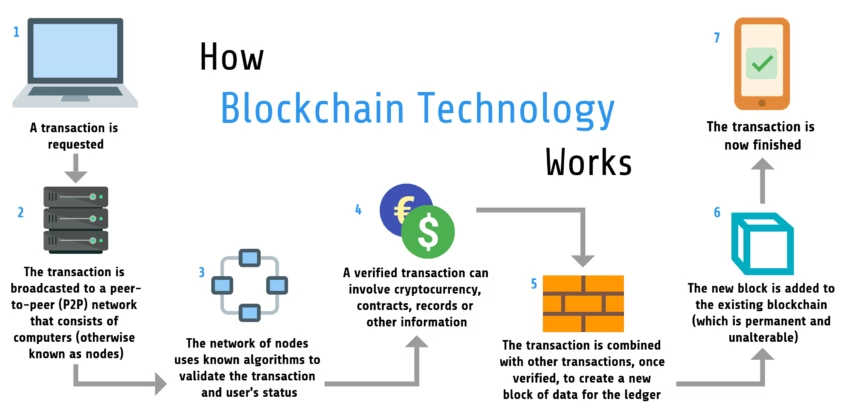
Blockchain does not store any of its information in a central location. Instead, the blockchain is copied and spread across a network of computers. Whenever a new block is added to the blockchain, every computer on the network updates its blockchain to reflect the change.
No mining also means better latency, accounting for faster validation and processing of transactions in the network. Once a node receives a transaction, it can confirm it immediately, without having to wait for a new block to be formed. This may not be as prominent, when compared to blockchains with fast or moderate block times, for instance Ethereum or Litecoin. But when compared to Bitcoin and Bitcoin Cash, the difference in time is more pronounced.
Why do all cryptocurrencies rise and fall together
These psychological factors contribute to market volatility. Investors who act impulsively often face negative outcomes, especially during periods of extreme price fluctuations. Understanding these dynamics can help investors make more informed decisions and avoid falling victim to emotional trading.
Cryptocurrencies, especially Bitcoin, have shown a correlation with traditional markets like the S&P 500. These markets are influenced by macroeconomic factors such as inflation rates, GDP growth, and unemployment rates. Therefore, when these factors affect traditional markets, they also impact the cryptocurrency market, leading to a coordinated movement.
First of all, cryptocurrencies are unregulated assets. That means that central authorities, such as banks and regulatory authorities can’t affect cryptocurrencies in the same way as they usually can with regular currencies and assets. See the stock market for instance – here, central authorities can regulate the price of assets with the purpose of stabilising the price. But that’s not a possibility with cryptocurrencies, as cryptocurrencies are decentralised currencies. Read more about the meaning of decentralised in our blog post “What is cryptocurrency?”.
A cryptocurrency’s underlying technology and adoption levels can significantly impact its price trajectory. Positive developments such as protocol upgrades, partnerships with established companies, or increased adoption for real-world use cases can instil confidence among investors, driving prices upwards. On the other hand, technical glitches, security vulnerabilities, or failed projects can erode trust and lead to price declines. Ethereum’s price surged in 2021 following the announcement of the Ethereum 2.0 upgrade, which promised improved scalability and reduced energy consumption.
Demand is another critical factor in cryptocurrency price movements. When more people want to buy a cryptocurrency, its price goes up. Conversely, when demand decreases, prices fall. Trading volume often reflects this dynamic. For example, the global cryptocurrency market saw trading volumes peak at $3 trillion in November 2021, showcasing how investor activity can drive price changes.
